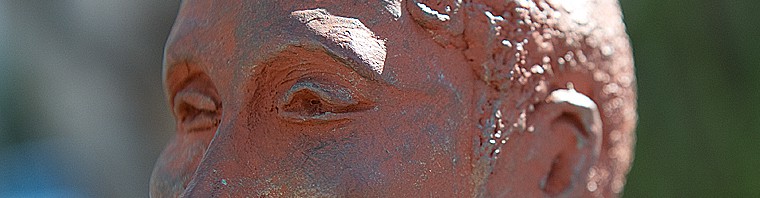
When the dog dies, it is as if a beloved friend suddenly stops talking to you.
As dogs can’t speak, this metaphor is an imperfect one, but the hole that is left in your life, in each case, is of a similar shape. So the imperfection of the metaphor is apt.
The experience of the dog no longer being there is a strange one, foreign, alien. Even if it was foreseen, even if you had a hand in it, nothing entirely prepares you for the death of the dog.
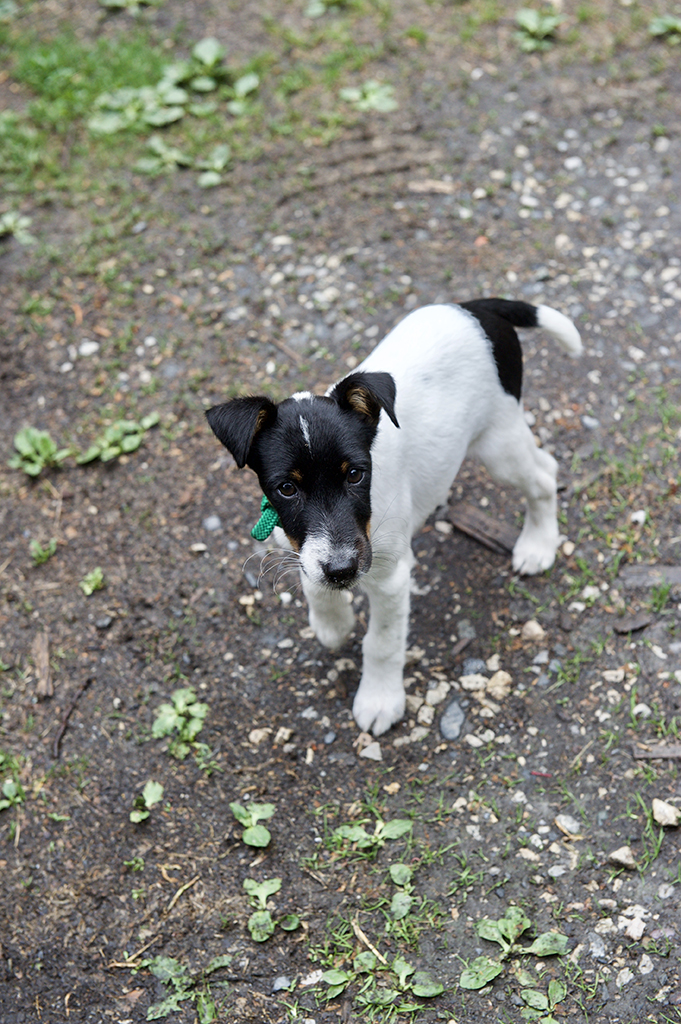
Snag as a Puppy
In the case of the dog Snag, his fate had been sealed well over a year before, when glands in his neck became swollen and angry. I instinctively knew what was to come the moment I felt them. As it turned out, the whole journey was very different than I imagined it would be: longer than I expected, and, curiously, of much better quality. He lived a full and vibrant life for almost 16 months – through 20 sessions of chemo — before his health fell off a cliff face and the inevitable became inevitable.
I don’t believe dogs understand language in any fundamental sense. Although they are well-attuned to our emotions, I think any words we speak don’t convey detailed meaning to them, only emotional content. I think you can be as articulate as you want with your dog, but all that conversation is just a series of growls or purrs, yelps and yaps to him.
As Arthur C. Clarke once wrote, “I often talk to my dog, but I don’t keep it up for very long.”
And yet they are keenly attuned to our emotions, especially sadness. A dog will come to you when you are feeling down; he will nudge you with his muzzle, and, in his own imperfect way, propose a walk or a game of tug. It seems very clear to me that this is not just the dog asking to do what he loves most: it is the dog trying to help. All my dogs have sensed when I have been sad. All my dogs have helped me through sadness.
Once, in Snag’s case, this was particularly laden in pathos, as he tried to comfort me when I was sad about his upcoming fate.
And so back to the imperfect metaphor. As they don’t have language, a dog quite literally cannot stop talking to you. But a friend can go silent. The severance, the deprivation, the shunning, is quite different, compared to the demise of the dog. But somehow the hole that is left is similar. The silence of the friend is heavier, more viscous, more resistant to movement. But in both cases, it becomes harder for one to advance through life.
When I was in university, I was taught that the difference between a metaphor and a simile is mostly just phrasing. A simile typically compares things relatively, using terms like “as if” or “is like”. A metaphor just kind of slams them together in blunt contrast.
So “An apple is like an orange.” is a simile; “Her smile is sunshine.” is a metaphor.
Although I believe simple phrasing is still the official distinction, I think it misses the true point. A metaphor contains much more tension than a simile; not just in how it states things, but in the things it compares.
There is no fundamental tension in the statement “An apple is like an orange.” It is easy to see how they are similar; it is clear the speaker is not claiming they are identical. Another telling fact is that you can reverse the order, and not really do damage to the sense of the simile: “An orange is like an apple.” is a perfectly equivalent statement.
To borrow a mathematical term, a simile is commutative.
I don’t believe true metaphors work that way. Inverting the order of my opening line changes the sense completely: “When a beloved friend suddenly stops talking to you, it is as if the dog dies.”
And even though both versions of the statement contain “as if”, and therefore would be classified as similes, to my ears, anyway, they just plain aren’t.
Perhaps a more concise, but self-referential way to express the distinction is: my statement is too metaphoric to be a simile.
On to the metaphorical hole that is left in your life. Truth be told, I actually miss Snag in a very different way than I thought I would. His absence is not ever-present, as I imaged it would be. Sometimes I forget he is no longer there. I can go for long periods, even walks, without thinking about him much. But then some small reminder comes from out of the blue, and hits me very hard, as devastating as a punch to the solar plexus. I see another dog who reminds me of him; absent-mindedly, I put a dirty pot down for him to lick out, and only 20 minutes later realise it is not going to get any cleaner. I return to the house after shopping and it seems cold and empty.
But I am getting used to all that.
Finally, for a metaphor to contain tension, I think there have to be substantive differences between the things it brings together. Apples and oranges just don’t differ enough to qualify. Although the dog’s death is final, it surely was not intentional. On the other hand, the silence of a friend is not final, as it can always be repealed; that it is intentional, voluntary on their part, is at once both a source of hope and of grief. Not the same things at all, so contrasting them provides that necessary metaphoric tension…
Everyone asks me if I will get another dog. It is the same question I have asked my own friends who find themselves in a similar situation. It is the same question I have asked myself. The answer is yes, emphatically, yes, but after a pause (paws?).
Sort of out of respect for Snag, but also sort of because I need a break. It has been a long haul.
And regards that “out of respect”: In a curious way, “another dog” would not be a replacement, but a continuation.
Happily, it is like that with dogs. Not so much with friends. An individual friend can never be replaced.
In a letter to his brother Theo, Vincent Van Gogh once wrote…
“If you don’t have a dog — at least one — there is not necessarily anything wrong with you, but there may be something wrong with your life.”
Like friends, there is something essential about dogs.
With thanks to BP (aka MS), IS, JC, VC and KA, without whom, in their particular ways, these thoughts would not have come to me.
And of course, to Snag.
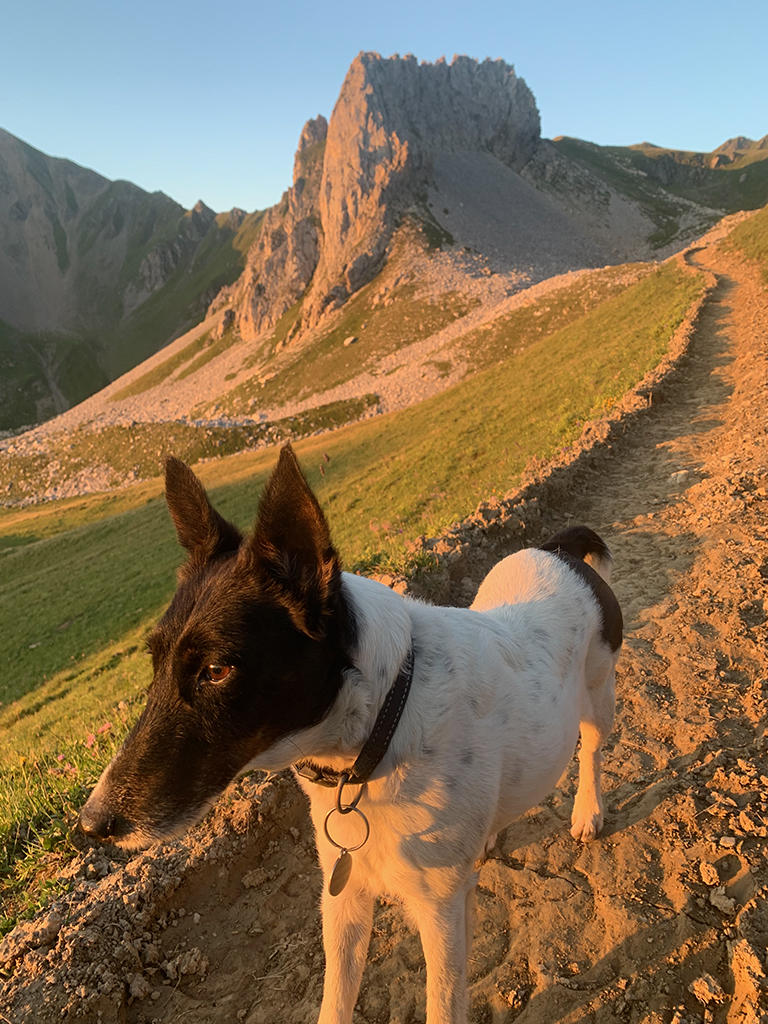
Snag in the Mountains